

What Is Ads.txt and Why Is It Important for Website Monetization?
When a website uses programmatic advertising, buyers need a way to know which companies are really allowed to sell that site’s ad inventory. Ads.txt provides a simple public record for this purpose.
This guide explains what ads.txt is and why it matters for website monetization in simple English.
What Does Ads.txt Mean?
Ads.txt stands for Authorized Digital Sellers. It is a plain-text file that a publisher places on the website domain to list advertising systems and accounts that are authorized to sell or resell its inventory.
Google’s official ads.txt guidance says ads.txt is not mandatory for AdSense, but Google strongly recommends it.
Where Is the Ads.txt File Located?
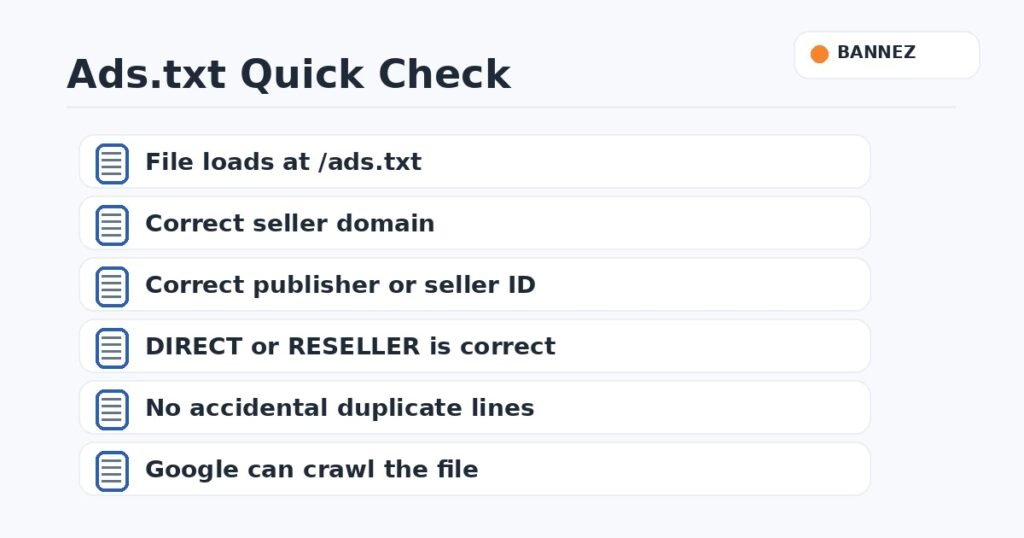
For a normal website, the file should be publicly available from the root domain, such as:
https://example.com/ads.txtThe file should load as readable text without a password or error page.
What Does an Ads.txt Line Contain?
A standard seller record normally identifies the advertising system, the account or publisher ID, the relationship type, and sometimes a certification authority ID. Use the exact information supplied by your ad network or partner.
What Does DIRECT Mean?
DIRECT means the publisher directly controls the account represented in the seller record.
What Does RESELLER Mean?
RESELLER means another company is authorized to sell your inventory through an account it controls. Google’s ads.txt FAQ provides more detail about these relationship types.
Why Ads.txt Is Important
1. It Helps Buyers Identify Authorized Sellers
Buyers can check whether the seller offering your inventory is listed by the publisher.
2. It Helps Reduce Unauthorized Inventory Sales
Ads.txt makes it harder for an unrelated seller to claim it is authorized to sell your website’s inventory without appearing in your public file.
3. It Supports Cleaner Partner Management
When you work with AdSense, AdX, or other monetization partners, ads.txt gives you one place to maintain seller authorization records.
Common Ads.txt Mistakes
- The file is missing from the root domain.
- The publisher ID is wrong.
- DIRECT is used when the relationship should be RESELLER.
- Old partners remain in the file without review.
- Security or redirect rules block crawlers.
- The file contains HTML instead of plain seller records.
How Often Should You Check Ads.txt?
Review it whenever you add, remove, or change a monetization partner. It is also useful to check the public file periodically so a CMS update, security rule, redirect, or hosting change has not broken access.
Does Ads.txt Increase Revenue?
Ads.txt does not create traffic or guarantee higher RPM. Its purpose is seller authorization and transparency. However, an incorrect or missing authorization setup can affect how some programmatic buyers treat your inventory.
Need Help With Ads.txt?
If your file shows errors, wrong seller records, or continued warnings, Bannez offers Fix Ads.txt Errors & Website Ad Setup Issues. Our team can review the website-side setup and help correct common implementation problems.
Frequently Asked Questions
Is ads.txt only for Google?
No. Ads.txt is an industry standard used across programmatic advertising, not only Google products.
Can I list several ad networks?
Yes, when those companies are genuinely authorized to sell or resell your inventory.
Should I copy another website’s ads.txt?
No. Seller IDs and relationships are specific to the publisher and its monetization partners.
Conclusion
Ads.txt is a small file with an important job: it tells the advertising market who is authorized to sell your inventory. Keep it accurate, public, and matched to your real monetization relationships.
